Showing posts with label autism spectrum disorder. Show all posts

Sunday, October 3, 2010

The Dance of Autism

In one year, Anton made strides in most developmental domains. His improvement was so phenomenal, we assumed it would go on forever. But it did not.

One month after the first anniversary of his diagnosis, Anton regressed. All of a sudden, he seemed like the same boy who was evaluated at the dev. ped.'s office a year ago. He was barely talking. He was once again getting his message across through tantrums, screams and whining. He also began to resist routines he used to take on effortlessly. Eating time used to go on with little resistance but all of a sudden, Anton was rejecting (through screaming) even his most favorite foods. What really bothered me and made me worry again was that he stopped responding when his name was called. He had also resumed his old mannerism of looking at objects using peripheral vision. I knew then that I had to get back to work again.

With autism, it seems like you go through phases like this- as they say, "2 steps forward, one step back.". I panicked at the thought that my son was regressing. Then I stopped myself again; very much like i did when he was first diagnosed. I looked at Anton during a quiet moment and thought, what am I complaining about? Here he is going home from school with 2 stamps, potty trained and communicating his needs. We were not just 2 steps forward, we were 12 steps forward! If I had to deal with 3, 5, even 7 steps back, I would gladly take those anytime.


There are good days...


...and there are bad days.

It's been like this since we started living with autism. We celebrate victories and tackle obstacles. Anton's teacher said to me yesterday on the bus going to the school's field trip (Repertory Philippine's Sleeping Beauty), "if he falls asleep in the bus, he will not get to watch the play!" To which I said, "that's good- he will survive two hours of theater, asleep lang nga." She looked at me thinking I was joking, then I caught her by surprise when I said, "small victories, small victories." She nodded her head and tried to understand.

One night after an awful tantrum at bedtime, I told my husband, "he's smart, you know. He's learning to manipulate us." We both laughed because even that was an achievement in itself. Anton was almost four and therefore he was expected to play these games. I started to think, if he was a typical 4 year old, wouldn't he beg and whine to stay up 'til late? Of course he wouldn't scream 'til his throat hurts (because he would be able to reason verbally) but the message would be the same.

So, when he approached the dining table and saw the sinigang on the table, he tried to turn back but I pulled him toward the table. I made him look at the food and then I said, "do you want sinigang?" He stared at the food, took 3 seconds longer than a typical child to answer then he said, "No." "Do you want chicken wings ?" (Wings were a sure favorite.) And just as fast as a typical child would respond, he said, "yes," and sat down in anticipation. I said, "bye-bye, sinigang," and so did he.

If this happened last week, I would have forced the sinigang, we would be in a contest over who wins, and then there would be a stalemate. Not this week. I realized just a few days ago that part of the developmental expectations for a four-year old (aside from trying to manipulate) would be making choices and expressing preferences. For a long time, I was under the impression that he "had to" eat what was on the table. I now know, that like a typical 4-year old, he will like some foods and hate others- and he will make it known.


He used to love these GFCF pancakes. Now, he won't even go near them.

So, rather than fighting over who wins the food game, I let him take control. I realized that behavior management is not a contest- I don't have to win. And maybe, by allowing him to take control, he will trust me more and trust the power of communication, as well. This encourages him to talk more, and reason out. Now if I can only get the yayas to learn the technique.

These last few weeks have been really tough on both Anton and me. For Anton, when the walls were pushed back, when the limits were relaxed, he was at a loss once again. He had gotten used to the structure and the expectations from before that when the grownups started being complacent, the best way he knew to cope was to regress to his pre-intervention state.

As for me, things with Anton had been getting so bad that, instead of addressing the problems, I pushed him further to misbehave. I was so caught up in the "why is he regressing?" that I didn't see that his "negative behaviors" were actually brought about by age-appropriate impulses. I was so obsessed with the autism that I failed to see how my son was growing up in a very typical way.

One step forward, two steps back? Twelve steps forward, 4 steps back? What I realized is that it really doesn't matter. It could be any dance- the cha-cha, foxtrot, "Roger Rabbit," even the Metallic Gigolo. You really don't have to know the steps. You just have to go with the flow.


My son has the moves! He takes after Mom. (Or is it Dad? He did the coconut dance in high school, too, you know.)

Saturday, July 17, 2010

The Cost of Autism

I have sat through many conferences and seminars on autism. In one such event early this year, a woman was giving a testimony on how Auditory Integration Therapy (AIT) brought wonders to her son with autism.

She said, "it is a bit expensive, but I am willing to try anything, spend money on anything because if I don't, I will never know whether it is effective or not for my son. After all, if it means that he will get better, pera lang yan (it's just money)."

I sat there stunned but commiserating with her. I would do anything, give up anything, spend anything for Anton's recovery. Then as I was about to sign up for AIT, I stopped myself. I was not thinking clearly. I was swept by the tide of hope that this woman had brought to the room. I knew her personally from another place and I believed she was telling the truth. But I realized, "my son is 3, hers is 7. I will do AIT after I have exhausted (and failed in) all other traditional means."

I bought an autism journal, "A Day at a Time" from Fully Booked. In it I listed recent therapies and supplements Anton has used. I also used the journal help with toilet-training.


By listing down what it was we were currently doing, I was able to see where we were still lacking. I had speech therapy twice a week so I decided to increase frequency to three times a week. I felt that better communication skills would help Anton in other problem areas as well.

Upon the dev. ped.'s recommendation, he now has SPED (Special Education) tutorials once a week. This was important, she said, to ensure that Anton is coping and absorbing concepts taught in his regular preschool.

We continued occupational therapy (OT) sessions twice a week, focusing on behavior modification and sensory integration. I also actively scheduled trips to new places like restaurants and malls in order to desensitize him to new environments. As for me, I began recipe-testing of Gluten-Free, Casein-Free (GFCF) dishes.

All in all, our schedule looked like this:


An ASD mom I recently met asked me in a (sort of) demeaning tone, "isn't that too much? Won't he be stressed?" I said to myself, "I have until age 6 to make a dent. When he's 7 he can slow down; but not now when it is most critical and most effective.

Just today, I watched Anton while waiting at the therapy center. He went to the SPED room at 12 noon, then after an hour stepped out and went into the OT room. After OT at 2pm, he went to the Speech Therapy room. I watched him "swing" from teacher to teacher, looking for signs of stress in his face. I knew he was tired (and maybe hungry) but right before his 2pm "speech" session, he was in the hallway saying "sunflower, sunflower" while smiling. I knew then that he would make it 'til the end. And he did.

My husband always scoffs when I say, "pera lang yan." At P 14,000 a month on therapies, it is not small change we are spending to help Anton get better. But one look at him now and we can see how all the time and money invested in Anton has paid off. We are in a good place and making steady progress.

During a visit to the dev. ped. last week the doctor said that kids with ASD who are diagnosed early have specific milestones that they have to meet by age 5. In panic, I asked, "so is that the deadline, 5 years old?" The doctor looked at me, smiling, and said, "what are you talking about? Anton has already met the 5 year old milestones... he will be okay."

My heart leaped and tears filled my eyes. No matter what my husband or anyone says, pera lang yan.


Watch out, world!

Saturday, July 3, 2010

Siblings

During my grieving stage, I was so engrossed in the pain I was feeling that I neglected to see how autism was affecting my other children. Anton is younger brother to Polo, 17 years old during diagnosis, and Abby, 7 (at that time). He is also kuya to Issa, who was 1 last year.


My four babies, December 2009

Polo studies in the US so when his baby brother was diagnosed, he was far from the chaos. When I told him about the autism, however, he said, "what's that?" Being a typical California teen, Polo has become very independent. He still loved his siblings deeply though and it showed every time he would come to visit the Philippines. I knew that he worried about Anton after his baby brother was diagnosed. He would also be excited about new developments and looked forward to Skype calls to see how the other kids were doing.


Polo, Anton and Mama, Christmas 2009

Issa was too young to even know that something serious was happening. She continued to grab toys from Kuya and was always in his way. Having been the "surprise" baby, Issa (since birth) had to sacrifice for his Kuya Anton. In the womb while Anton was only five months old, she was not given the prenatal attention that all the other kids had. Mama was too busy raising an infant.

Even when Anton was a newborn, Ate Abby was always jealous of the attention we gave to our baby boy. She wanted to join him in the crib to play. She also used to say, "do you love Anton more than me?" Abby was the hardest to be hit by the diagnosis, let alone the presence of the babies. She had gotten used to her monopoly of parents' attention (Kuya Polo was too old to be jealous when Abby was born), that every praise or positive comment given to the babies was met with, "what about me?"

After the diagnosis, sibling dynamics did not change when it came to Issa. She continued to be the baby who had to give in to her older siblings. My relationship with her, however, suffered. My obsession with recovery kept me from spending time with my other children. I played with them occasionally but whenever they would play with Anton, I was always cautious that Anton would not have a meltdown. So they had to give in to him most of the time. Also, I did not realize it until later but whenever they would play, I would always interfere to make it a pseudo-therapy session.


The three little ones- Issa, Abby and Anton

Abby went with me to the dev. ped.'s office on August 7 but she never knew anything was wrong until I explained it to her almost three months later. The truth about Anton had to come out because Abby had started to exhibit negative behavior at home and in school just to get my attention. All of a sudden, Abby was bossing her classmates around and was treating yayas badly. She also started to say, "I don't want to play with Anton, he keeps grabbing my stuff."

I knew I had to set aside time to be with my two daughters even if my schedule was packed with events related to Anton. This was part of the reason why I decided to go back to being a full-time mom a few months after the diagnosis. While I was still employed part-time, however, my Ate got Abby a book entitled, "There's a Duwende in My Brother's Soup." Although the child in the book is a more typical autism case, it was good for Abby to see how a child with autism acts and how his family adjusts to their special child.

Abby learned the same lessons in "Spinning," a book I bought at the Autism Society of the Philippines convention in November 2009. I had the author and illustrator sign Abby's copy so that she would be excited to read the book. She asked me, "how come Anton doesn't spin?" I said, "because not all kids with autism are the same. Anton likes to line up things, right? That's what makes him different."


These were very effective in helping Abby understand her brother.

The most important purchase I made to address the sibling issue was a DVD called "Understanding Brothers and Sisters on the Autism Spectrum." I read from reviews on Amazon.com that this DVD was effective for other families. Abby liked watching the DVD because it was age-appropriate and because puppets were used to relay the message. Even Anton and Issa enjoyed watching the puppets!

After repeatedly watching the video, Abby finally understood that Anton needs special care. It was still important for me, however, to guide her when interacting with her brother. One day she said, "I don't want to play with Issa, she doesn't have autism." I knew that it was not enough to have told Abby once, I will have to keep watching over her and her siblings whenever they play. Sometimes she would say, "look mom, Anton and I are playing with Lego!" or she would grab the babies' hands and play, "ring around the rosie." She tries to become a mini-me when it comes to her baby brother.


Abby always reads to Anton

Last year, Abby added to the stress and desperation of the diagnosis but nowadays she has lived up to her "Ate" title. Well, of course, unless Anton tries to dismantle her Lego creation or Issa attempts to break her crayons.

Issa is a spoiled, "kulit" baby and she exercises her "bunso" privilege always. She would grab a toy from Kuya Anton and run away with it screaming (like she was the victim); or she would say "I want Kuya Anton sit down;" or she would jump on the bed and land on a "hiding" Kuya Anton. I realized after seeing all this why God gave me Issa. She was the playmate Anton needed to help him snap out of his "space out" moments. She was given to us because Anton needed to learn to socialize and share. Most of all, he needs to learn how to act appropriately because he is Issa's big brother.


Issa forces Kuya to share

I often get teased by my friends that Anton is my favorite. Honestly, I don't know if that's true. It's just that my baby boy is so sweet and affectionate (unlike his sisters) that I can't help wanting to be around him most of the time. He may or may not be my favorite but now that I have four children, I have proven that you love each one differently.

Polo was my hero in the 90's- his birth redeemed me from the craziness of youth and rebellion. Abby was my much-awaited daughter, the one who keeps nagging me and reminding me how I can be a better mother. Issa will always be mama's baby, my cuddly bundle of joy who I am now able to rightfully treat as my "bunso." And of course, Anton; without whom I would not have realized the depths of my love for my family. Whatever anyone says, I am blessed!

Sunday, June 27, 2010

Grandparents

The minute I found out about Anton's ASD I was texting my mother. Unlike many important milestones in my life, I felt that this was one thing I had to tell my mom immdediately. This, even if we do not have the closest relationship. In fact, ours has always been rocky. But, I don't know why, the moment my world was shattered, it was my mom (next to Allen, my husband) from whom I wanted to hear comforting words.


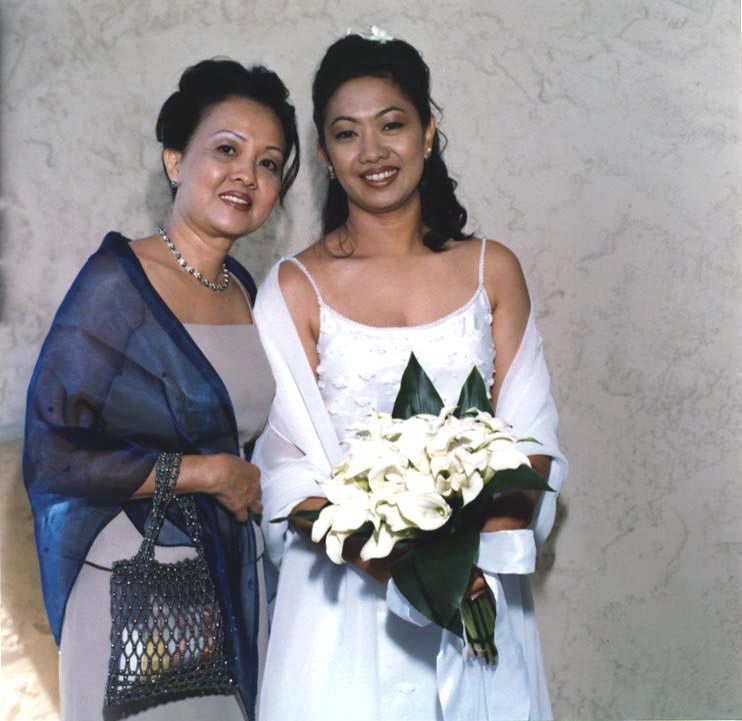
Mama and me, wedding day 2001

Mama also wondered why Anton had not been speaking a lot at age two. But like me, I think she did not want to believe that something was wrong. She said, "no kidding?" when i texted her. Being a strong Catholic, she also promised me that she will be saying novenas for Anton's recovery.

In the days after, Mama would visit the house often. She would watch Anton and I would explain more about autism. I would say, "o, try to call him, he won't respond" or "see, he won't look at you when you talk to him?" For my mother, it was a learning process too. She would say, "how come during my time this wasn't uso (common) yet? Look at Tita Toots' son, Mike, didn't they say he had it? Look at him now? He's okay, he has a job, he has friends." I would then say, "sana nga, sana nga (I wish, I wish)."

Mama was very much like me, trying to be optimistic but very grounded in the fact that recovery might be tough. She was always available for a chat and to give advice. She would also try to lift my spirits up and offer to take me out (maybe because she knew it was tough having to deal with the diagnosis alone since Allen was in the US).

The biggest gift Mama gave me, however, is the inspiration to have faith. She would often say whenever I would tell her about a crisis, "sige, ipagdadasal ko (okay, i will pray for it)." Her trust in God has always been amazing; sometimes, I used to think, a little too blind. Throughout her trials, many of which seem impossible to overcome, she has always believed in miracles.

After the initial depression that happened to me, I was back to my novenas and bible. I may seem like the many who run to God for help, but I was always very grateful for what I was blessed with- my family and a comfortable life (even after the diagnosis). I think that the reason I stopped crying all the time was because I learned to accept what has happened to Anton and believe that he will have a better life one day. It is because of Mama that I developed faith.


Christmas 2006, Mama and Papa babysit Anton in California

Just like Mama is like me, Papa is like Allen. Because he is so obsessed about natural health and alternative medicine, I worried that if I told my dad about what happened to Anton, he would blame me. Throughout most of my adult life, Papa was always nagging about eating healthy foods and taking supplements. So I feared that he would blame my unhealthy lifestyle, yet again, for Anton's condition.

I grew up very distant from my father. He was very busy with his career during my youth. Throughout the angst of my adolescence, we rarely saw eye-to-eye. I always felt that I was a failure to him; that I had disappointed him with the things I had done in the past. Many times, I felt like I was not loved by my parents, but mostly by my dad. I would have probably chosen not to tell him about Anton for as long as I could but my cousin found out about the autism and I knew it was just a matter of time before news would reach my father.

It took us nine months to tell Papa about Anton's ASD . We all met for breakfast that Sunday morning. Throughout the meal, no one seemed to be willing to open up about it. Finally, Mama said, "Maya wants to tell you something." I didn't enjoy being put on the spot so I said to Allen, "you say it."

Allen told Papa that we took Anton to see a specialist and she said that he has autism. "So what?" Papa said, so untrue to his opinionated character. "That means he will be great like me!" We laughed. What I thought would be a crying morning turned out to be hilarious. Papa said, "all geniuses were considered weird. Imagine if he could harness his assests and turn them into something productive- watch out!" Allen, Mama and I just sat there, sort of laughing but sort of teary-eyed. Papa took the negativity out of the disorder and turned it into something positive!

Having been agnostic most of his life, my father rarely drew strength from faith in a higher being. His success is a testament of his own strength, determination and stubbornness. And if my father has optimistic words to say about Anton, I think it is because he was once considered weird too, having been mildly crippled by polio in his youth. So for Papa to be so positive about my son, for him to brush off the gloom of the situation, for him to attempt to banish doubt from my mind about recovery- for Papa that is love. It may not be the most typical form a child expects from a parent, but I knew that he believed it so much and he wanted me to believe it too. Just like Papa was weird, so was how he showed his love; but I'll take it any day.

Allen was elated that Papa saw the disorder the same way he did, "see? I told you," he said to me. I was happy to realize then, that maybe it's a man-thing. What may seem to be denial is an optimism women may not have at that low point in their lives. Maybe, we may not be willing to admit it, it is what we need. Baseless or not, it does help to lighten spirits sometimes and may even be contagious for the short term.

Being a parent has allowed me to see things the way my own parents did. I may not have approved of how they handled parenthood back then but I have learned to understand them better. I may not have had a good relationship with them during my youth but I'm glad that I have them now that I need them most.


"Wowa" and "Wowo"

So different yet so similar, Mama and Papa have supported me through Anton's autism in totally different ways. One believes in God, one thinks he is a god. One is supportive even when I am negative, the other is so harsh about the need to be positive. She believes I should do all I can, he thinks Anton will do all he can and overcome it. Opposing opinions but in the end, one message- HE WILL BE BETTER... that's all I need to know that I am loved.

Wednesday, June 23, 2010

In sickness and in health?

Did they mean Anton's sickness?

Allen and I were equally shocked with Anton's diagnosis. The similarity seemed to end there. With Allen's shock came anger- at the dev. ped. "How can she come up with this diagnosis after seeing Anton for 2 hours?!...I'm gonna sue her!" To give him a lot of credit, though, he said "I don't believe he has autism, but let's do what we have to do to help him get better." We decided to focus on making him better instead of focusing on the label "autism".


Anton, 5 months old, and Dada

We both knew Anton could not be a serious case of autism. He was on the verge of talking! He also did not have the typical behavior of other children with autism (CWA)- no hitting, banging head on floor, flapping arms, spinning. All he really obsessed about was lining up objects on the floor. Allen and I were both optimistic that Anton would overcome this; but Allen more than me.

"He's okay. He'll be fine. Look, he's starting to talk!" Allen would say to try to calm me down during my ASD depression moments. I couldn't believe him fully. I've read so many things about ASD that I feared the worst- an non-verbal adult who was still in diapers, helpless and alone.

I decided to dedicate my time to making him better. I would do all I can even if it would be costly. I went online, I bought books, I bought videos, I bought therapy materials, I made a lesson plan, I enrolled Anton in OT 2x a week and, eventually, Speech Therapy 2x a week. I was looking into the Gluten-Free, Casein-Free diet and Auditory Integration Therapy.

Allen started to get annoyed at my obsession. He kept reassuring me that we didn't need all these things. That, one day, he would be "normal." He kept squashing my efforts towards non-traditional methods of treatment. I started to feel that he was being unsupportive. This was when I started to understand why statistics say that 50% of marriages in the US end in divorce when a child is diagnosed with autism.

Slowly, I was starting to feel alone in the battle. Not only did I have to deal with the pain of the diagnosis, I had to deal with a husband who did not seem to be grieving as much as I was. He could not understand that the reason why I was so obsessive was because I wanted to be sure that Anton would be "normal" eventually.

One day, in the early months after the diagnosis, I heard the sounds of Anton's meltdown from the playroom. Dad was in the room with him. It seemed that Anton wanted to get out of the room to go to me but could not verbalize the request (or the adults could not understand) and so he ended up in a full-blown tantrum.

I screamed through the door, "stop forcing him to talk! It's too late. He cannot control himself anymore." Allen opened the door and shouted, "I know what I'm doing... Why do you always act like you're the expert on this? You make me feel so inept."

I was stunned. I did not think that my "expertise" on the disorder would be seen as a hindrance instead of help. I told him, "this isn't about you. It's about Anton. You don't know how to handle him because you don't want to learn more about how to." Let's just say it was quiet in the house for a few days after that exchange.

As time passed, Allen started listening to me when I talked about what I learned through research and reading. He kept quiet whenever I would sign up and attend seminars and conventions. He started to copy my actions towards Anton. Most of all, it seemed like he realized that we were not enemies in this. It was autism that was the enemy.

I knew everything was alright when, one day, during a quiet moment while watching Anton sleep I asked Allen, "do you really think he will be better?" Allen replied, "he will be okay..." and then quietly and bravely, "and if not, THAT is okay too." I looked at him and knew- we wouldn't be part of the divorced 50%.


Anton, Mama and Dada during Anton's 2nd Birthday party

I don't know if Allen has ever grieved. I think he did not grieve because his faith was stronger than mine in believing that Anton would overcome it. Slowly, our son is showing that his father was right.

I don't think I am wrong to worry though. I think it is that nagging, annoying worrying that is pushing me to keep helping Anton. Now that he is verbal and (almost) toilet-trained, I just have to work on my fear of his being helpless and alone.

Tuesday, June 22, 2010

Moving On

We were diagnosed on a Friday. I was in Fully Booked buying ASD books on Saturday. By Monday, we found an Occupational Therapist (OT). Things seemed to be happenening quickly.

The doctor recommended the following: OT, Speech Therapy, SPED (Special Education) school. The OT was the easiest to find. It would be two months until we would find a speech therapist.

As for the SPED school, my husband and i both felt that it would be a dis-service to Anton to expose him to lower-functioning children. His language was emerging and he did not have the repetitive behaviors (spinning, flapping arms, rocking back and forth) that lower-functioning ASD children have. Our fear was that he would copy these behaviors and would actually regress instead of improve. (I have a story about this later.)

So, Anton continued to go to a Montessori school. The teachers were devastated at the diagnosis but knew that he would survive in a Montessori classroom. Even if he cried for the first two months of classes, eventually he settled in and got used to the routine.


Anton at work in Maria Montessori Children's School

Because of OT, there were big improvements in his behavior. The whining lessened and his behavior improved. The OT also worked on strengthening his gross and fine motor skills as well as improving his competence in Activities for Daily Living (ADL).

A week after our diagnosis, my adrenaline and hopes were up. We were starting our journey called "early intervention." But after trying for weeks to get a speech therapist, I was feeling helpless again.


Sometimes I feel like we're running around in circles with no definite direction. Then I stop myself because I'm sure he feels worse.

When you're diagnosed, you think that your doctor will hold your hand throughout the process. You assume that you will be given a "manual" of things to do. You believe that a path is being paved for your child's journey. After getting a second opinion from another dev. ped. six months after the first diagnosis (and the results were the same, by the way), I knew that our family was on this journey alone.

Doors will not open. Therapists will not fall on your lap. Doctors will not follow up on your child's condition. In the end, your child's future is in your hands. You look for the therapists and if you don't find one that you like, move on to (or more like "wait" for) the next. You bug the doctor's office for referrals and recommendations. You find alternative methods of treatment.


Some OT videos I bought from Amazon.com. Good for yaya and you to watch to turn playtime into a home OT session.

Only you will give up your time, money, your life, to make him better. When I realized this, things were easier. I knew I had to move on my own. That I shouldn't wait for referrals, that I shouldn't put all my hopes on a home program that has a wait-list 5 months long (btw, I still don't have a slot), that I should not believe everything I am told, read, and hear, and mostly, that I shouldn't blame.

It's easy to say, "the doctor promised me a slot in..." or (to my husband) "you're not helping me." (More on spouses soon!) But in the end, what does it do? Nothing. So, though it seems like I always get stuck in a rut and have to do this, I move on. I focus on Anton, I focus on what I can do. Never mind what others are not doing. I have to do all that I can.

Anton was diagnosed August 7. He started verbalizing requests later that month. He started playing with other kids in November. He started singing nursery rhymes in March, He started pretend-play in May. He was spelling words by June.

Things may not be happening as fast as they did during that first week after the diagnosis, but I'm okay with that. I'm okay with slow but surprising changes. I'm okay with small steps. I'm okay with all the starts that Anton has been achieving. It is because of all these small "starts" that Anton will finally finish this journey.


Anton's first nursery rhyme (or maybe the first one we understood!)

Finding Out

They say a mom always knows when something is wrong with her child. I know now that before Anton turned 1 1/2 years old, everything about him was normal. But when he turned two, I became scared that Anton was not talking as much as other two year-olds. Everyone said it was "normal," though, since boys usually talk later than girls. My husband, Allen, said that he was a late talker too and my older daughter Abby took to talking rather slowly as well.

So when Anton started going to school at 2 years, 8 months and the teacher said that "he doesn't establish eye contact, no?" and, "i think receptive language is good but expressive is weak," I felt, "so what's new? He'll be fine!"


Anton, 2 years 2 months, and Mama

Three months passed and he was not fine. He seemed to be stuck in the developmental stage of a 1 1/2 year-old child. During our first PTC, teacher said, "his tantrums are really bad, maybe you want to consider going to a developmental pediatrician." So even if I wanted to believe that Anton was "normal," I did.

During the "dev. ped's" initial assessment, Anton was fidgety and uncooperative. He kept grabbing toys, whining, screaming. He did not finish the assessment because he had already fallen into a full-blown tantrum. Since it was a two-hour assessment at 2pm (naptime), and since we were in the waiting room for an hour and a half, I felt that his behavior was justified. After all, these things were expected during the terrible twos, right?

When the dev. ped. began discussing the results of the evaluation, I knew that she wasn't about to give me good news but what she said was way beyond what I feared. AUTISM SPECTRUM DISORDER (ASD)... ha? what's that? how? curable? She said that in the US, 1 in 150 children have ASD. Having read so much about ADHD while living in the States and knowing that it was quite a serious condition, I remember asking her, "is this worse than ADHD?" Her answer? "Yes. ADHD can be treated but ASD is lifetime."

Results of Evaluation (chronological age 2 years, 9 months):
Gross motor - 1 year 10 months
Personal Social - 1 year, 1 month
Hearing and Speech - 1 year, 6 months
Fine Motor - 1 year, 11 months
Nonverbal - 1 year, 9 months


I cried all the way home. I texted my husband (who was in the US), my mom, and my Ate. I cried that night, and I cried for almost 3 months after that. Sometimes I still cry. Often I feel helpless.

The morning after I found out, I was at Fully Booked waiting for the store to open. I searched for the "Autism" section worried they would not have it. But I guess the doctor was right, it was more common than I thought- 3 whole rows on ASD. Before that day i had never bought anything at Fully Booked because items were so expensive. I went home that day with P 3,000 worth of books on ASD.


The first 3 (of many more) books on ASD that I bought. Application of techniques learned from the rightmost book, "What You Can Do Right Now..." immediately brought improvements in Anton.

I cried while I read. But I learned more. I also started to hope. There was no cure, but there is hope for the better. Within the day I had learned so many strategies to use on Anton. I applied them during the following days and within a week I saw an improvement. He was starting to come back to my world. He was slowly becoming the child I thought I had lost to this disorder.

I mourned a long time (like all moms with ASD kids do) but I decided to work with Anton while doing so. Thanks to the diagnosis I knew what was needed to make him better. If the doctor did not confirm my fears, I would still be thinking that all is well with Anton, and then realize in the future (when 6 year old Anton is still in diapers) that I should have followed my instinct.

Thank God for a mother's instinct. Thank God for my faith in a better future. Thank God for the wonderful blessing that is Anton. You WILL be better.